

You know that feeling. It is 4pm, you have just picked the kids up from school, and within twenty minutes your perfectly lovely child has turned into someone you do not fully recognise. Tears over nothing. Arguments about everything. The kind of meltdown that makes you quietly question every parenting decision you have ever made.
I have been there. Every week. Sometimes every day.
Here is what changed everything for me: I stopped treating it as a behaviour problem and started treating it as a food problem. As a health coach with an MSc in Clinical Nutrition and a mum of two, I have seen this pattern hundreds of times, both in other families and in my own kitchen. The 4pm crash is one of the most predictable, most misunderstood events in a child’s day. And it is almost entirely preventable.
What's Actually Happening to Your Child's Body at 4pm
By 4pm, most children have been awake for nine or ten hours. They’ve spent the day concentrating, socialising, managing big feelings, and running around at break, all of which burns glucose at a steady rate.
Research shows that children’s brains use approximately twice as much glucose as adult brains, making them far more sensitive to drops in blood sugar. [1]
If their last proper eating moment was lunch at noon or 1pm, they’re running on empty. Blood sugar has dropped. And when blood sugar drops, the brain does not just get tired. It gets stressed. The body releases cortisol and adrenaline to compensate [2], which is why the crash doesn’t just look like tiredness. It looks like aggression. Tearfulness. An inability to regulate emotions or tolerate the smallest frustration.
Why It Looks Like Bad Behaviour (But Is Not)
In other words: it looks exactly like bad behaviour. But it isn’t. It is a physiological response to an energy gap. The brilliant, kind, curious child you dropped off at school this morning is still in there. Their blood sugar is just running the show right now.
Once you see it that way, the solution becomes obvious. This is not a parenting problem. It is a fuel problem.
Why "Just Give Them a Snack" Doesn't Actually Work
The standard advice is simple: give kids a snack after school. So parents hand over crackers, a piece of fruit, a cereal bar, a pack of rice cakes, and then wonder why their child is still melting down twenty minutes later.
Here’s why: most of those foods are almost entirely fast-releasing carbohydrates. They spike blood sugar quickly, which feels better for about fifteen minutes, then blood sugar drops again, sometimes lower than it was before. You’ve bought yourself a small window and then made the crash worse.
Studies confirm this: the glycaemic load of what children eat directly predicts their mood and behaviour in school. [3] A randomised controlled trial published in the British Journal of Nutrition found that children who ate a lower-glycaemic breakfast showed better mood and memory later in the day compared to those who ate a high-glycaemic breakfast. [4]
The problem isn’t that they need something. It’s what they need that matters.
The Power of Three: How We Structure Eating in Our House
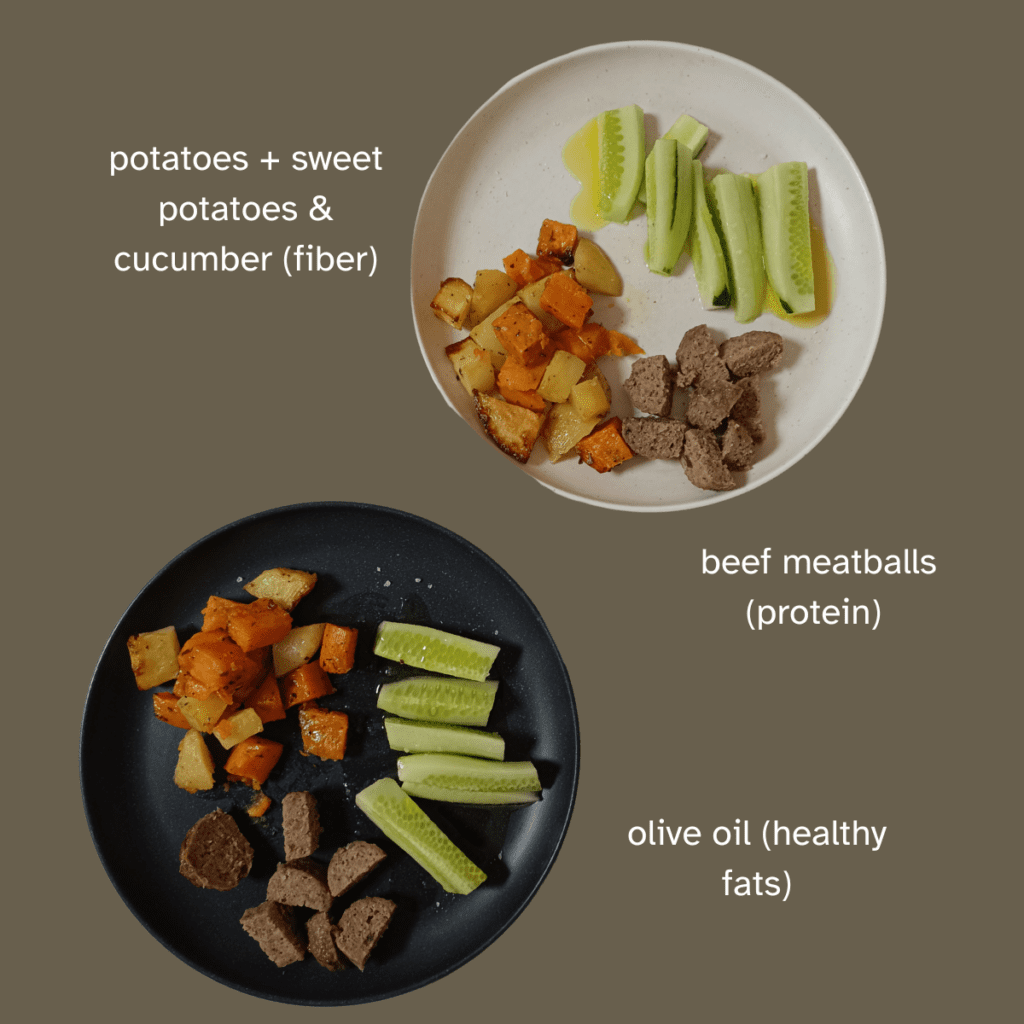
In our family, we don’t really do snacks in the traditional sense. What we do instead is structure our day around four proper eating moments, each one built around what I call the Power of Three: protein, fat and fibre.
That combination is the only thing that produces a slow, sustained release of energy. Protein slows digestion and reduces postprandial glucose peaks. [5] Fat further slows glucose absorption from the gut. [6] Fibre feeds the gut microbiome and, through short-chain fatty acid production, further smooths the glucose response. [7] Together, they are the difference between a blood sugar roller coaster and a child who comes home from school and can actually hold a conversation.
Our four eating moments look like this:
- Breakfast: protein + fat + fibre
- School lunch: protein + fat + fibre
- 4pm meal: protein + fat + fibre (this is the one people call a snack)
- Dinner: protein + fat + fibre
Notice I don’t call the after-school one a snack. It’s a meal. A smaller one, yes, but a meal. That shift in how you think about it completely changes what you serve.
What the 4pm Meal Actually Looks Like in Our House
It does not need to be elaborate. In our house it usually looks like one of these:
- Full fat Greek yogurt with a handful of berries and a tablespoon of almond butter. Protein from the yogurt, fat from the almond butter, fibre from the berries. Done in two minutes.
- A small plate of last night’s leftovers. Literally just opening the fridge and plating something. Bolognese, a grain bowl, some chicken and roasted veg. The 4pm meal is the easiest of the four to put together because it is almost always a leftover.
- Cheese, cucumber and oatcakes. Protein, fat, fibre. Takes ninety seconds.
- Hummus, veggie sticks and a boiled egg. My children eat this three times a week and they still ask for it.
- A smoothie with full fat Greek yogurt, frozen spinach, frozen mango and a tablespoon of nut butter. This one looks like a treat. To them it is. They don’t know about the spinach.
None of these take longer than five minutes. All of them follow the same three part formula. None of them cause the blood sugar spike and crash.
The One Change That Makes the Biggest Difference
If I had to pick a single change that has the most impact on the 4pm crash, it is this: making sure breakfast also follows the Power of Three.
Blood sugar is cumulative across the day. A child who starts the morning with cereal and juice has been riding a glucose roller coaster since 7am. By 4pm, their system is genuinely depleted, and no after school meal can fully compensate for eight hours of spikes and crashes.
The evidence supports this. A systematic review found that breakfast composition and energy contribution directly affects children’s cognitive performance and behaviour throughout the school day. [8] What you serve at 7am matters at 4pm.
A breakfast that includes protein (eggs, Greek yogurt, nut butter, seeds), fat (full fat dairy, avocado, nuts) and fibre (oats, fruit with skin, vegetables) sets a completely different physiological baseline for the whole day. School lunch maintains it. The 4pm meal tops it up.
What This Means for Your Day
The 4pm crash, in my experience, is usually the consequence of two or three previous meals that didn’t hit the mark. Not just what you hand them at the door.
Once you start thinking about your child’s eating across the whole day, and once every meal includes protein, fat and fibre, you will be amazed at how much calmer the after school window becomes.
We are not perfect in our house. Some days it’s cold leftovers eaten at the door. Some days the 4pm meal is yogurt in the car between school and football practice. Some days dinner is late and the 4pm meal has to carry more weight than usual. But the structure is there, and that structure is what carries us through the chaos.
Frequently Asked Questions
My child says they're not hungry at 4pm but then melts down at 5pm. What do I do?
The “I’m not hungry” at 4pm is almost always a blood sugar signal in disguise. When blood sugar is very low, appetite can become confused. Children often feel slightly nauseous rather than clearly hungry. Offer something small with no pressure: a few cubes of cheese, some hummus with crackers, a small pot of yogurt. Once blood sugar starts to stabilise, you’ll almost always find they eat more than they said they would.
Won't a 4pm meal mean they don't eat dinner?
Not if it’s appropriately sized. We’re talking a small plate, not a second dinner. In practice, I’ve found the opposite is often true: children who have their blood sugar stabilised at 4pm come to dinner calmer and more willing to try what’s on the table. When they arrive at dinner already in a meltdown state, eating well is the last thing they’re capable of.
What if my children are at after school clubs until 5pm or 6pm?
Pack it. A small container with full fat Greek yogurt, some leftover rice and chicken, or cheese and oatcakes in a lunchbox will do it. The timing matters enormously. If they can eat something in the car at 5pm, the evening will look entirely different to waiting until dinner at 7pm.
Is this relevant for toddlers too, or just school age children?
Completely relevant. Toddlers’ blood sugar is actually more sensitive because their glucose reserves are smaller. The pre-dinner chaos is very often blood sugar related. The Power of Three applies at every age. The portion sizes change, the textures change, the foods change, but the formula stays exactly the same.
Do I need to count anything or track macros?
No. This is not about numbers. It’s about a simple checklist every time you put food in front of your child: is there a protein here? Is there a fat? Is there fibre? If the answer to all three is yes, you’re done. That’s the whole system.
Final Thoughts
The 4pm crash is not a discipline problem. It is a physiology problem, and a very solvable one. Once you start thinking about your child’s eating across the whole day, and once every meal includes protein, fat and fibre, you will be amazed at how much calmer the after school window becomes.
Try it for one week. Build every meal around the Power of Three and watch what happens at 4pm. I promise you’ll notice the difference before the week is out.
Christina is a health coach with an MSc in Clinical Nutrition, and a mum of two based in Greece. She writes about practical family food, blood sugar balance and raising adventurous eaters at livewellbychristina.com.
References
- Ells LJ et al. (2022). The Effects of Breakfast and Breakfast Composition on Cognition in Children and Adolescents: A Systematic Review. Advances in Nutrition. Read study
- UCSF Diabetes Teaching Center. Blood Glucose and Stress. Read more
- Mahoney CR et al. (2005). Effect of breakfast composition on cognitive processes in elementary school children. Physiology & Behavior. Read study
- Micha R et al. (2011). Glycaemic index and glycaemic load of breakfast predict cognitive function and mood in school children. British Journal of Nutrition. Read study
- Rains TM et al. (2015). Effects of Higher Dietary Protein and Fiber Intakes at Breakfast on Postprandial Glucose and Insulin. Nutrients. Read study
- Wolever TM et al. (2023). The Effects of Fat and Protein on Glycemic Responses in Nondiabetic Humans. Journal of Nutrition. Read study
- Dahl WJ et al. (2021). Dietary Fibre Modulates the Gut Microbiota. Nutrients. Read study
- Hoyland A et al. (2013). The effects of breakfast on behavior and academic performance in children and adolescents. Frontiers in Human Neuroscience. Read study
Read Similar




Affiliate Disclaimer: This website may include affiliate links, which means I may earn a commission if you click through and make a purchase. This comes at no additional cost to you and helps support the content and resources I provide. I only recommend products and services I genuinely believe in and that align with the values of this platform. Your trust is important to me, and I’m committed to transparency. Thank you for your support!